Grueso Chapa de acero HRPO puede llegar plano y dentro de las especificaciones, pero acabar combado, retorcido o deformado de cualquier otra forma tras el corte. Esto no significa necesariamente que el material fuera defectuoso. En muchos casos, la deformación se debe a tensión residual en el interior de la placa la redistribución que se produce al retirar el material, junto con los efectos térmicos derivados del proceso de corte.
Para los compradores y fabricantes de acero, es importante comprender este mecanismo porque espesor de la chapa, método de corte, geometría de la pieza y secuencia de procesamiento Todo ello puede influir en la forma final.
¿Por qué se puede deformar una placa plana de HRPO tras el corte?
Que una placa esté plana no significa que esté libre de tensiones internas
Una chapa de acero puede parecer plana aunque contenga tensión residual derivados de procesos de fabricación como la laminación en caliente, el enfriamiento, el enderezado y los cambios de temperatura.
Estas tensiones pueden estar relativamente equilibradas mientras la placa completa permanezca intacta. Como resultado, la placa puede cumplir los requisitos de planitud aunque sigan existiendo tensiones internas.
El corte altera el equilibrio de tensiones
El corte elimina material y, por lo tanto, modifica la distribución de las fuerzas en la chapa restante.
El proceso simplificado es el siguiente:
Antes de cortar: Las tensiones internas están equilibradas dentro de la placa.
Durante el corte: Se retira material y, en el caso del corte térmico, se aplica calor de forma localizada.
Después del corte: El material restante redistribuye la tensión y alcanza un nuevo equilibrio.
If the stress distribution is uneven, the cut section may bow, curl, twist, or move out of plane.
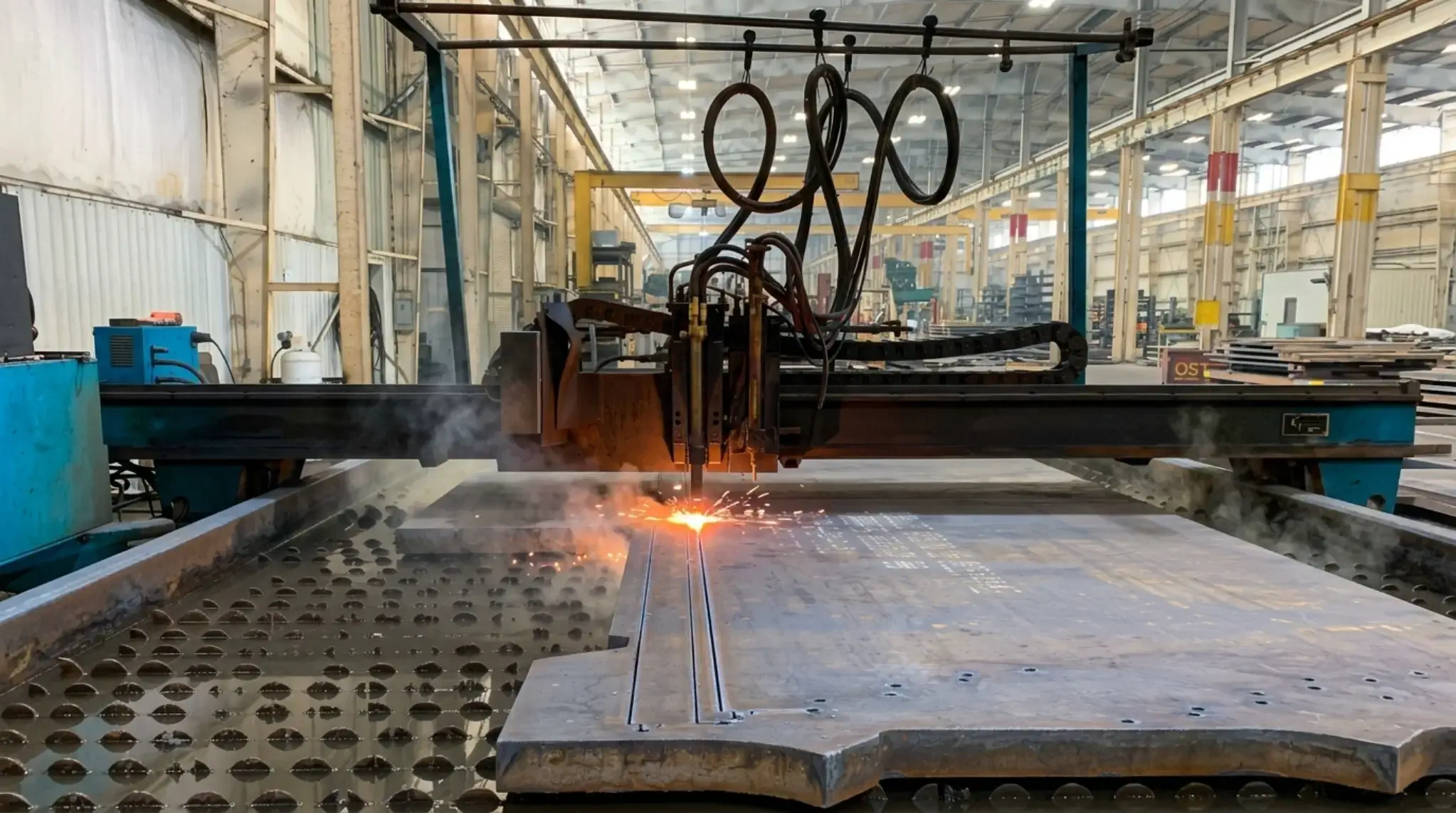
Cómo el estrés interno provoca la distorsión de corte
¿Qué es la tensión residual en las chapas de acero?
Residual stress is stress that remains inside steel even when no external load is applied.
Different regions of a plate can contain different levels and directions of residual stress. These differences can result from non-uniform heating and cooling or mechanical processing during steel production.
The important point is that a plate can be dimensionally flat while still having an internal stress state that becomes visible after cutting.
¿Por qué la eliminación de material libera tensión?
Consider a plate containing tensile and compressive stresses in different areas. When the plate is whole, these forces partially constrain one another.
Cutting removes part of that structure. The remaining material is no longer subjected to exactly the same constraints, so it can move until the internal stresses reach a new equilibrium.
This is why a large cut blank can deform even when the original plate showed no obvious distortion.
¿Por qué se puede deformar una chapa gruesa?
Greater thickness generally increases stiffness, but thickness does not eliminate residual stress.
A thick plate can still contain uneven stress distributions. If cutting removes a significant or asymmetrical portion of the plate, the resulting stress redistribution can produce noticeable deformation.
Therefore, “thicker steel is more rigid” and “thicker steel cannot warp” are not equivalent statements.
Cómo el calor de corte agrava la deformación de las chapas HRPO
El calentamiento local provoca expansión y contracción
Thermal cutting introduces another source of distortion.
The basic sequence is:
Heating → local expansion → cooling → contraction
The heated zone attempts to expand, while surrounding cooler steel restricts that movement. When the area cools, it contracts. Repeated or uneven thermal cycles can create additional stress around the cutting path.
¿Por qué es importante la aportación de calor?
The greater and more concentrated the heat input, the greater the potential for thermal distortion.
Important variables include:
- Método de corte
- Aporte de calor
- Cutting speed
- Plate thickness
- Cutting path
- Part geometry
This does not mean one cutting method is always better. The appropriate process depends on the thickness, tolerance, geometry, and production requirements.
¿Qué condiciones de corte aumentan el riesgo de deformación de la chapa?
Aberturas grandes o asimétricas
An irregular part can remove material unevenly from different areas of the plate.
L-shaped parts, long narrow blanks, and large internal openings can create an uneven redistribution of stress, increasing the possibility of deformation.
Recorridos de corte largos y continuos
A long cutting path can concentrate heat in one area for an extended period. If heat accumulates faster than it can dissipate, thermal distortion becomes more likely.
Secuencia de corte incorrecta
The sequence of cuts can affect how and when stresses are released.
If one area is completely separated while other areas remain connected, the newly released section may move before the remaining cuts are completed.
Parámetros de corte incorrectos
Improper cutting speed, power, flame settings, or other process parameters can increase heat input or produce an unnecessarily large heat-affected area.
For this reason, cutting quality is not determined solely by the machine. Process parameters and cutting strategy matter as well.
Métodos de corte de chapas HRPO y consideraciones relativas a la deformación
| Cutting Method | Main Distortion Consideration |
|---|---|
| Corte por láser | High precision, but thickness capability and heat input must be considered |
| Corte por plasma | Suitable for many plate applications; thermal distortion remains possible |
| Oxy-fuel cutting | Effective for thicker plate, but generally involves higher heat input |
| Mechanical cutting | Avoids thermal distortion but has limitations related to thickness and geometry |
Corte térmico frente a corte mecánico
The fundamental difference is the source of deformation.
Thermal cutting can cause distortion through localized heating and cooling, while mechanical cutting avoids thermal effects but can introduce mechanical deformation depending on the equipment and material thickness.
The right choice should therefore consider the required flatness, dimensional tolerance, plate thickness, geometry, and production volume.
Cómo reducen las empresas de transformación del acero la deformación tras el corte
Empieza por elegir el material adecuado para la placa
The condition of the incoming material matters. For applications with strict flatness requirements, processors should consider steel grade, thickness, plate condition, and residual-stress risk, rather than treating every HRPO plate as equivalent.
Controlar la aportación de calor
Appropriate cutting parameters can reduce unnecessary thermal stress.
This includes controlling cutting speed, power, and equipment settings according to the material and thickness. The objective is to achieve the required cut quality without introducing excessive heat.
Optimizar la secuencia de corte y el anidamiento
Cutting sequence and nesting affect both material utilization and heat distribution.
A well-planned cutting pattern can reduce excessive heat concentration and help manage how stresses are released as individual parts are separated.
Utiliza un procesamiento adicional cuando sea necesario
For applications with demanding flatness or dimensional requirements, additional processing may be appropriate, such as stress-relieving treatment, leveling, machining allowance, or controlled processing sequences.
These measures are not required for every HRPO plate. They should be determined by the material condition, part geometry, tolerance, and final application.
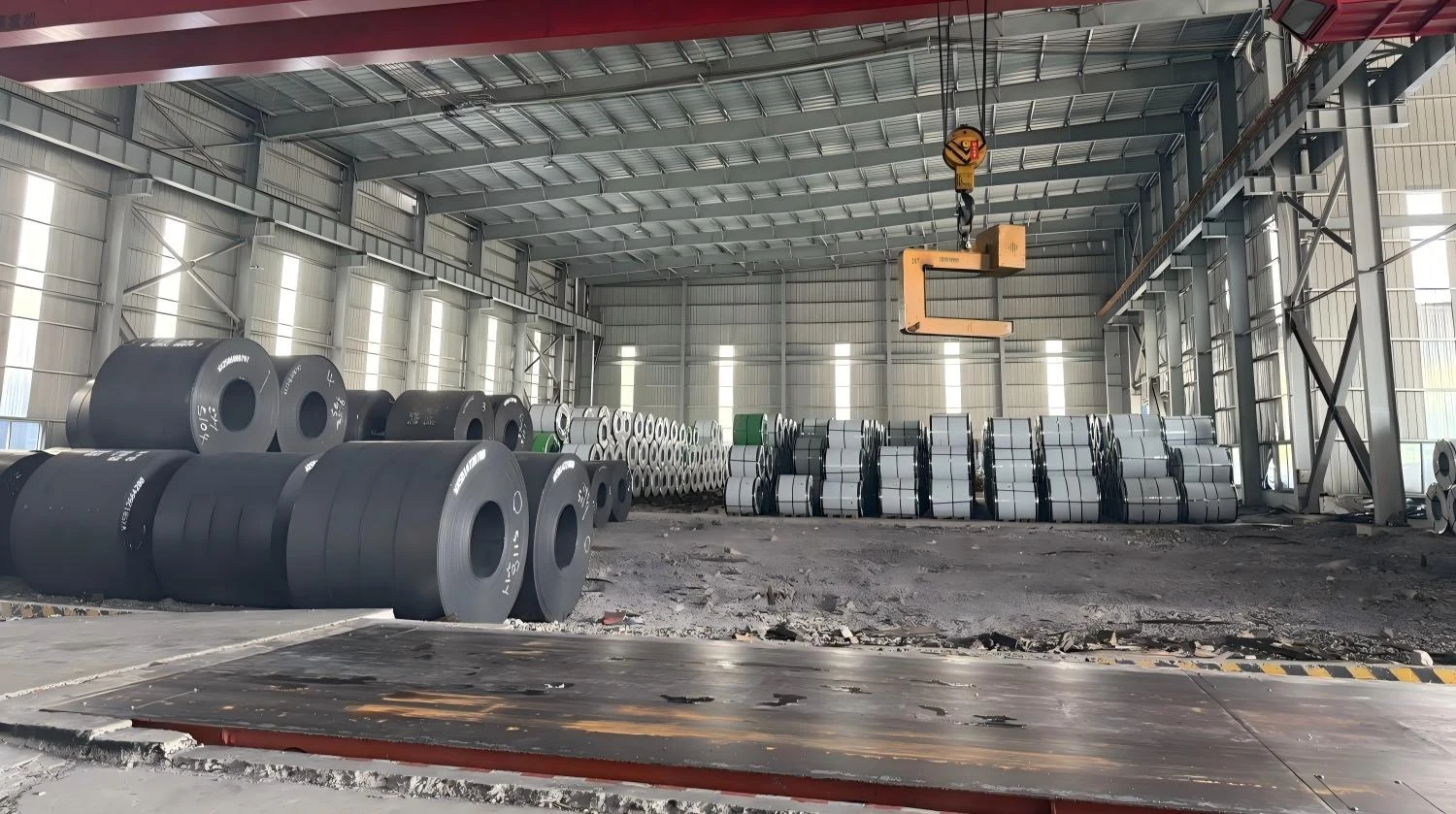
¿Qué deben tener en cuenta los compradores a la hora de encargar chapas de HRPO cortadas a medida?
¿Está claro el requisito de planitud de la pieza final?
A buyer should distinguish between simply ordering a plate cut to size and ordering a finished blank with specific flatness and dimensional requirements.
If the latter is required, those tolerances should be established before processing begins.
¿Es mejor comprar placas en bruto o placas pretratadas?
Buying raw plate may provide flexibility and reduce processing costs, but it leaves cutting and potential distortion management to the buyer.
For production applications, purchasing processed blanks can reduce downstream labor, equipment requirements, and the risk of inconsistent cutting results when the processor has appropriate capabilities.
¿El proveedor se encarga tanto del material como del corte?
Trabajar con un proveedor y transformador de acero can provide better coordination between material condition, cutting parameters, geometry, tolerances, and inspection.
Un experimentado Proveedor de acero de HRPO can evaluate the material and processing requirements together rather than treating steel sourcing and cutting as completely separate operations.
¿Cuándo debe considerarse la deformación tras el corte como un problema del material?
No todas las piezas en bruto deformadas indican que el acero sea defectuoso
Some deformation is a normal processing risk associated with residual stress release and thermal cutting. A flat incoming plate does not guarantee that every cut blank will remain equally flat.
The material and cutting process should therefore be evaluated together.
¿Cuándo es necesario realizar más pruebas?
Further investigation is appropriate when deformation is unusually severe or inconsistent, particularly when:
- Distortion significantly exceeds the agreed tolerance
- Problems repeatedly occur across batches
- Deformation varies substantially under similar cutting conditions
- Material properties do not match the specified requirements
- The cutting process cannot reasonably explain the result
A professional assessment should consider material condition, cutting method, cutting sequence, part geometry, and agreed tolerances before determining the cause.
Conclusión: Para controlar la deformación de las placas HRPO no basta con elegir acero de mayor espesor
Thick HRPO plate can still deform after cutting because thickness provides rigidity but does not eliminate residual stress.
The final shape of a cut part is influenced by the interaction of:
Residual stress + material removal + thermal effects + cutting sequence + part geometry
For buyers, the practical lesson is to define the finished-part requirements, not only the raw steel specification. When flatness and dimensional accuracy are important, choosing a procesadora de acero with control over material sourcing, cutting parameters, processing sequence, and inspection can significantly reduce downstream risk.
Un competente custom steel processing supplier should therefore be evaluated not only on the price of the HRPO plate, but on its ability to deliver a consistent finished product.