Thick صفائح فولاذية من نوع HRPO can arrive flat and within specification, yet become bowed, twisted, or otherwise deformed after cutting. This does not necessarily mean the material was defective. In many cases, the deformation results from residual stress inside the plate being redistributed when material is removed, combined with thermal effects from the cutting process.
For steel buyers and fabricators, understanding this mechanism is important because plate thickness, cutting method, part geometry, and processing sequence can all affect the final shape.
Why Can a Flat HRPO Plate Warp After Cutting?
Flatness Does Not Mean the Plate Is Free of Internal Stress
A steel plate can appear flat while containing residual stress from manufacturing processes such as hot rolling, cooling, straightening, and temperature changes.
These stresses may be relatively balanced while the full plate remains intact. As a result, the plate can meet its flatness requirements even though internal stresses are still present.
Cutting Changes the Stress Balance
Cutting removes material and therefore changes how forces are distributed throughout the remaining plate.
The simplified process is:
Before cutting: internal stresses are balanced within the plate.
During cutting: material is removed and, for thermal cutting, localized heat is introduced.
After cutting: the remaining material redistributes stress and reaches a new equilibrium.
If the stress distribution is uneven, the cut section may bow, curl, twist, or move out of plane.
How Internal Stress Causes Cutting Distortion
What Is Residual Stress in Steel Plate?
Residual stress is stress that remains inside steel even when no external load is applied.
Different regions of a plate can contain different levels and directions of residual stress. These differences can result from non-uniform heating and cooling or mechanical processing during steel production.
The important point is that a plate can be dimensionally flat while still having an internal stress state that becomes visible after cutting.
Why Does Removing Material Release Stress?
Consider a plate containing tensile and compressive stresses in different areas. When the plate is whole, these forces partially constrain one another.
Cutting removes part of that structure. The remaining material is no longer subjected to exactly the same constraints, so it can move until the internal stresses reach a new equilibrium.
This is why a large cut blank can deform even when the original plate showed no obvious distortion.
Why Can Thick Plate Still Deform?
Greater thickness generally increases stiffness, but thickness does not eliminate residual stress.
A thick plate can still contain uneven stress distributions. If cutting removes a significant or asymmetrical portion of the plate, the resulting stress redistribution can produce noticeable deformation.
Therefore, “thicker steel is more rigid” and “thicker steel cannot warp” are not equivalent statements.
How Cutting Heat Makes HRPO Plate Warping Worse
Local Heating Causes Expansion and Contraction
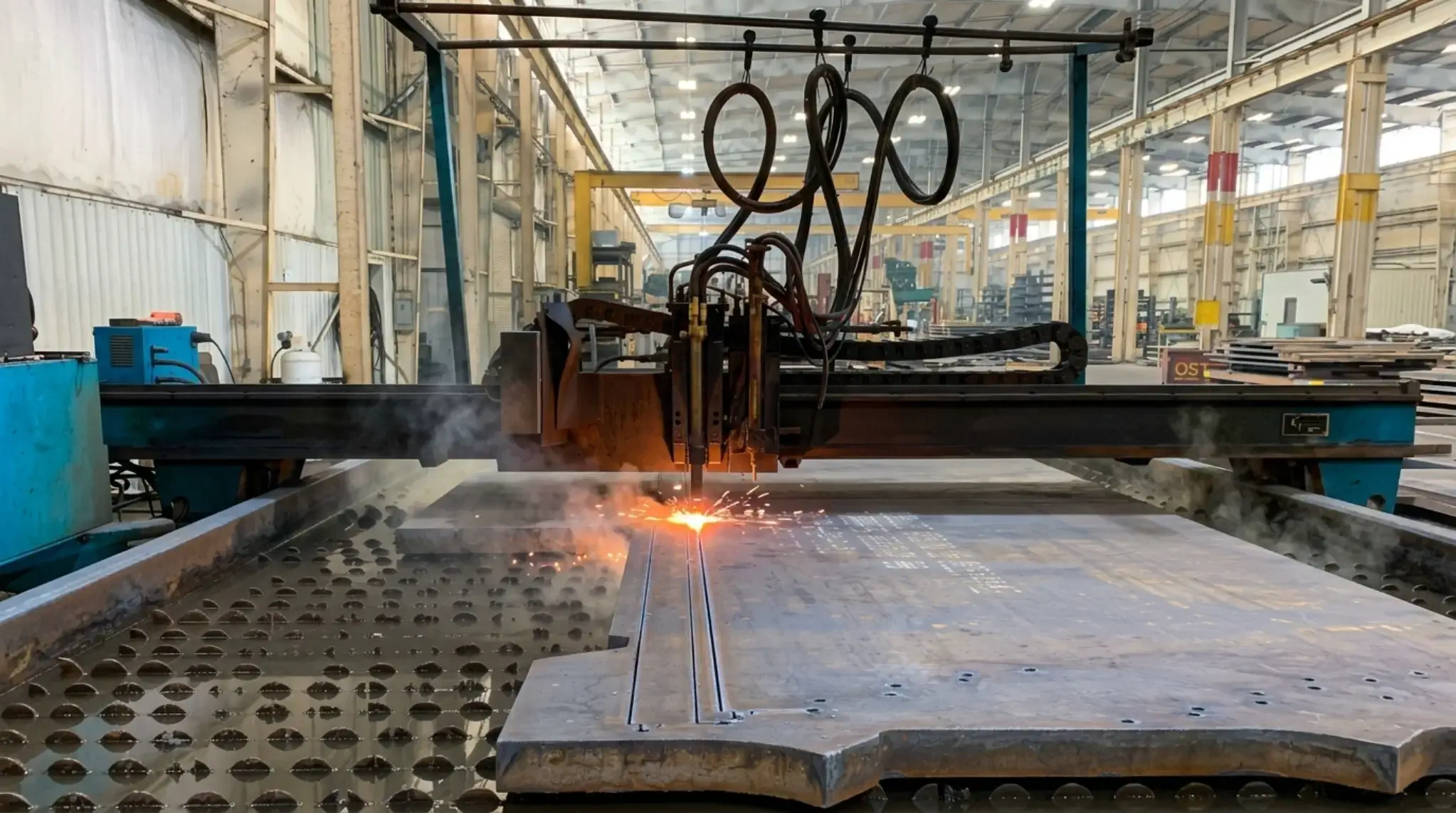
Thermal cutting introduces another source of distortion.
The basic sequence is:
Heating → local expansion → cooling → contraction
The heated zone attempts to expand, while surrounding cooler steel restricts that movement. When the area cools, it contracts. Repeated or uneven thermal cycles can create additional stress around the cutting path.
Why Does Heat Input Matter?
The greater and more concentrated the heat input, the greater the potential for thermal distortion.
Important variables include:
- طريقة القطع
- الطاقة الحرارية المدخلة
- Cutting speed
- Plate thickness
- Cutting path
- Part geometry
This does not mean one cutting method is always better. The appropriate process depends on the thickness, tolerance, geometry, and production requirements.
Which Cutting Conditions Increase the Risk of Plate Distortion?
Large or Asymmetrical Cutouts
An irregular part can remove material unevenly from different areas of the plate.
L-shaped parts, long narrow blanks, and large internal openings can create an uneven redistribution of stress, increasing the possibility of deformation.
Long Continuous Cutting Paths
A long cutting path can concentrate heat in one area for an extended period. If heat accumulates faster than it can dissipate, thermal distortion becomes more likely.
Poor Cutting Sequence
The sequence of cuts can affect how and when stresses are released.
If one area is completely separated while other areas remain connected, the newly released section may move before the remaining cuts are completed.
Incorrect Cutting Parameters
Improper cutting speed, power, flame settings, or other process parameters can increase heat input or produce an unnecessarily large heat-affected area.
For this reason, cutting quality is not determined solely by the machine. Process parameters and cutting strategy matter as well.
HRPO Plate Cutting Methods and Their Distortion Considerations
| Cutting Method | Main Distortion Consideration |
|---|---|
| القطع بالليزر | High precision, but thickness capability and heat input must be considered |
| القطع بالبلازما | Suitable for many plate applications; thermal distortion remains possible |
| Oxy-fuel cutting | Effective for thicker plate, but generally involves higher heat input |
| Mechanical cutting | Avoids thermal distortion but has limitations related to thickness and geometry |
Thermal Cutting vs. Mechanical Cutting
The fundamental difference is the source of deformation.
Thermal cutting can cause distortion through localized heating and cooling, while mechanical cutting avoids thermal effects but can introduce mechanical deformation depending on the equipment and material thickness.
The right choice should therefore consider the required flatness, dimensional tolerance, plate thickness, geometry, and production volume.
How Steel Processors Reduce Warping After Cutting
Start With Appropriate Plate Material
The condition of the incoming material matters. For applications with strict flatness requirements, processors should consider steel grade, thickness, plate condition, and residual-stress risk, rather than treating every HRPO plate as equivalent.
Control Heat Input
Appropriate cutting parameters can reduce unnecessary thermal stress.
This includes controlling cutting speed, power, and equipment settings according to the material and thickness. The objective is to achieve the required cut quality without introducing excessive heat.
Optimize Cutting Sequence and Nesting
Cutting sequence and nesting affect both material utilization and heat distribution.
A well-planned cutting pattern can reduce excessive heat concentration and help manage how stresses are released as individual parts are separated.
Use Additional Processing When Required
For applications with demanding flatness or dimensional requirements, additional processing may be appropriate, such as stress-relieving treatment, leveling, machining allowance, or controlled processing sequences.
These measures are not required for every HRPO plate. They should be determined by the material condition, part geometry, tolerance, and final application.
What Should Buyers Consider When Ordering Cut-to-Size HRPO Plate?
Is the Final Part Flatness Requirement Clear?
A buyer should distinguish between simply ordering a plate cut to size and ordering a finished blank with specific flatness and dimensional requirements.
If the latter is required, those tolerances should be established before processing begins.
Should You Buy Raw Plate or Processed Blanks?
Buying raw plate may provide flexibility and reduce processing costs, but it leaves cutting and potential distortion management to the buyer.
For production applications, purchasing processed blanks can reduce downstream labor, equipment requirements, and the risk of inconsistent cutting results when the processor has appropriate capabilities.
Does the Supplier Control Both Material and Cutting?
العمل مع... مورد ومعالج الصلب can provide better coordination between material condition, cutting parameters, geometry, tolerances, and inspection.
شخص ذو خبرة مورد الفولاذ لشركة HRPO can evaluate the material and processing requirements together rather than treating steel sourcing and cutting as completely separate operations.
When Should Warping After Cutting Be Treated as a Material Problem?
Not Every Deformed Blank Indicates Defective Steel
Some deformation is a normal processing risk associated with residual stress release and thermal cutting. A flat incoming plate does not guarantee that every cut blank will remain equally flat.
The material and cutting process should therefore be evaluated together.
When Is Further Investigation Necessary?
Further investigation is appropriate when deformation is unusually severe or inconsistent, particularly when:
- Distortion significantly exceeds the agreed tolerance
- Problems repeatedly occur across batches
- Deformation varies substantially under similar cutting conditions
- Material properties do not match the specified requirements
- The cutting process cannot reasonably explain the result
A professional assessment should consider material condition, cutting method, cutting sequence, part geometry, and agreed tolerances before determining the cause.
Conclusion: Managing HRPO Plate Warping Requires More Than Choosing Thick Steel
Thick HRPO plate can still deform after cutting because thickness provides rigidity but does not eliminate residual stress.
The final shape of a cut part is influenced by the interaction of:
Residual stress + material removal + thermal effects + cutting sequence + part geometry
For buyers, the practical lesson is to define the finished-part requirements, not only the raw steel specification. When flatness and dimensional accuracy are important, choosing a معالج الصلب with control over material sourcing, cutting parameters, processing sequence, and inspection can significantly reduce downstream risk.
كفء custom steel processing supplier should therefore be evaluated not only on the price of the HRPO plate, but on its ability to deliver a consistent finished product.