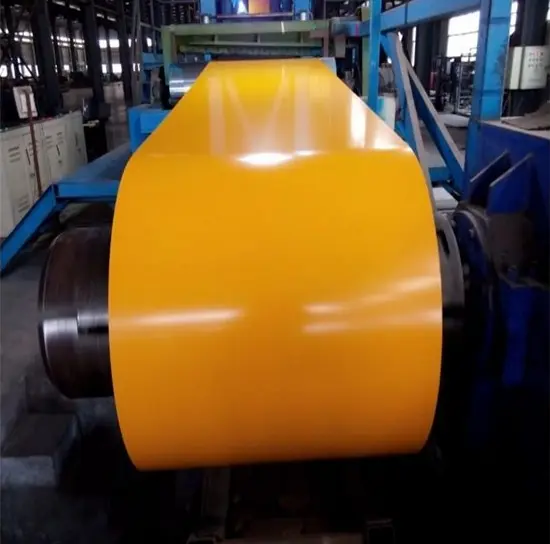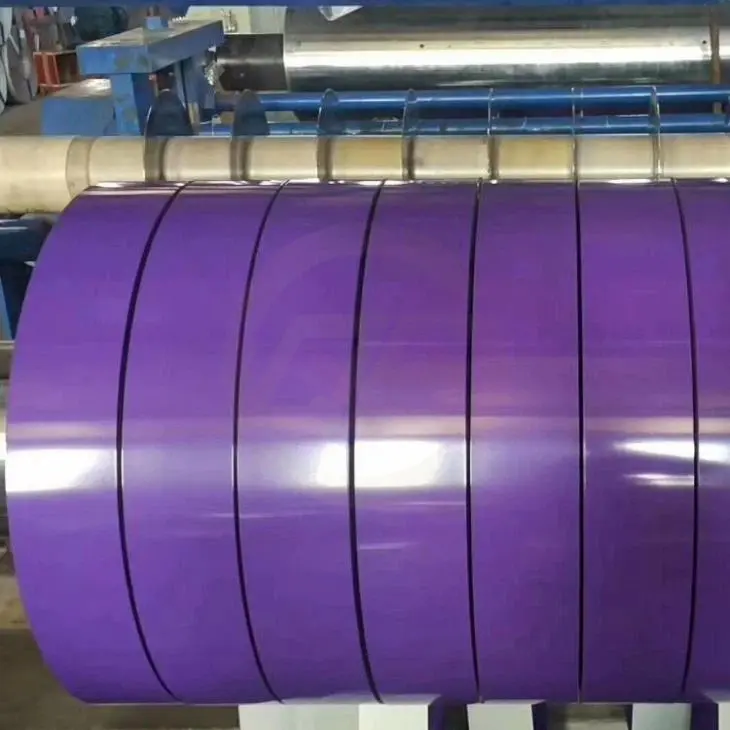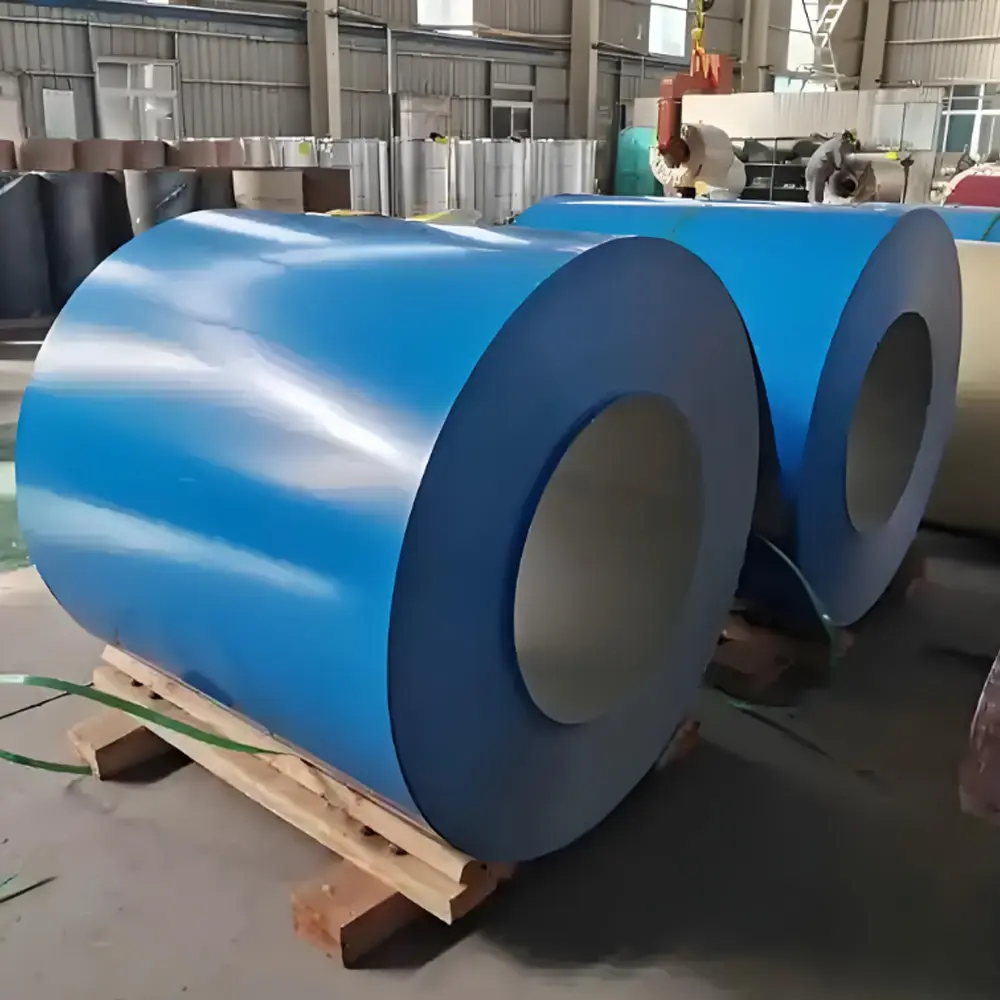
Steel coil slitting converts wide master coils into narrower strips for downstream manufacturing. However, every slitting run can generate material losses from edge trimming, inefficient slitting patterns, machine setup, processing defects, and unused coil remnants.
For steel service centers and coil processors, these losses directly affect material costs and production profitability. Even a small improvement in material utilization can make a difference when processing large volumes of steel.
Reducing scrap in coil slitting requires more than adjusting machine settings. From the perspective of a steel supplier and processor, it involves coordinating order planning, slitting pattern optimization, edge trimming, equipment maintenance, and production monitoring. This guide explains the main sources of scrap and practical ways to improve slitting yield without compromising strip quality or customer specifications.
Identify the Main Sources of Scrap in Coil Slitting
Before implementing improvements, processors need to understand where material losses occur. Different sources of scrap require different solutions, so tracking only total scrap weight may not reveal the underlying problems.
Edge Trim Waste
Edge trim waste is generated when the outer edges of a master coil are removed during slitting. This material may contain edge cracks, uneven edges, damaged areas, or other imperfections that make it unsuitable for the required finished strips.
The amount of edge trimming depends on incoming coil condition, edge quality, width consistency, and customer requirements.
Excessive trimming reduces the usable width of the master coil. However, reducing trim width too aggressively can leave defects in the finished strips and cause downstream quality problems.
The objective is to remove only the material necessary to achieve the required edge condition and product quality.
Slitting Setup and Start-Up Scrap
Setup scrap is generated during machine preparation and production adjustment. It can occur when operators thread the coil, position the slitting knives, adjust tension, or stabilize the strip-running process.
Common causes include:
- Incorrect knife positioning or clearance.
- Repeated adjustments to strip width.
- Unstable tension during start-up.
- Misalignment between the incoming coil and slitting line.
- Trial runs required to achieve acceptable edge quality.
Poorly standardized setup procedures can increase waste, particularly when processing frequent small orders or changing product specifications.
Defect-Related Scrap
Material may also become unusable when slitting produces defects that exceed customer specifications.
Common examples include:
- Burrs: Excessive burr formation caused by unsuitable knife clearance, worn blades, or incorrect setup.
- Width deviation: Finished strips fall outside the specified dimensional tolerance.
- Camber: Strips develop excessive lateral curvature.
- Surface damage: Scratches or handling marks reduce product acceptability.
- Coil winding defects: Uneven tension or poor alignment creates unstable or damaged finished coils.
These defects can lead to rework, downgraded material, or customer rejection. Preventing them is generally more effective than attempting to recover material after quality problems occur.
Unused Width and Coil-End Waste
Unused width is the portion of the master coil that remains after the required strip widths and edge trims have been accounted for.
For example, a slitting pattern may produce several acceptable strips but leave a narrow remainder that cannot be used economically in the same production run.
Coil-end remnants can also become difficult to process when the remaining length is insufficient for another order or when handling and setup costs outweigh the value of the material.
These losses are often related to production planning rather than machine performance.
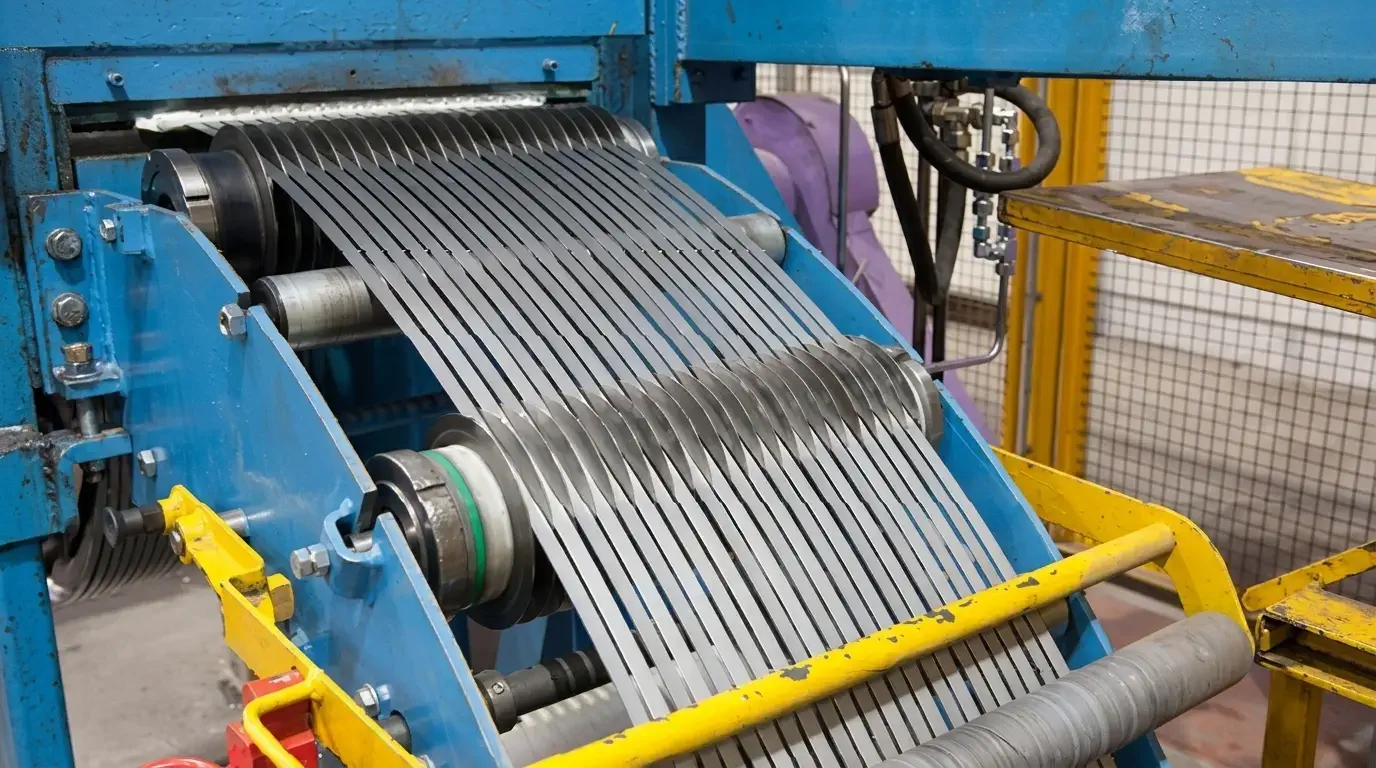
Optimize Slitting Patterns to Improve Material Utilization
Slitting pattern optimization is one of the most direct ways to reduce width-related scrap. It determines how the available master coil width is divided into finished strips.
A well-planned pattern should maximize usable output while meeting dimensional tolerances, equipment limitations, and customer requirements.
Match Master Coil Width with Required Strip Widths
The first step is to compare the incoming master coil width with the widths required by customer orders.
For example, a processor receiving a 1,250 mm master coil needs to determine which combination of finished strip widths can use the available material most efficiently.
A poor combination may leave a large unused section even when the machine operates correctly. A more suitable combination can convert a greater proportion of the master coil into saleable products.
When planning a slitting pattern, consider:
- Master coil width.
- Required finished strip widths.
- Number of strips for each width.
- Necessary edge trim.
- Knife quantity and positioning.
- Equipment limitations and minimum strip width.
The goal is not simply to fit as many strips as possible. The finished widths must remain within customer specifications, and the pattern must be practical for the slitting line.
Combine Compatible Orders in One Slitting Run
When production schedules allow, combining compatible customer orders can improve material utilization.
For example, a master coil may be used to produce several strip widths rather than processing one width combination that leaves substantial unused material.
However, orders should only be combined when their technical and production requirements are compatible.
Check the following before combining orders:
- Steel grade and material specification.
- Thickness and thickness tolerance.
- Surface and edge quality requirements.
- Required strip widths and dimensional tolerances.
- Coating or finish requirements, where applicable.
- Equipment and packaging constraints.
Combining incompatible orders can create additional setup work, quality risks, or delivery complications. Material utilization should not come at the expense of product consistency.
Consider Customer Tolerances and Production Constraints
Customer specifications influence how much material can be used in a slitting pattern.
If a customer allows a defined width tolerance, the processor may have some flexibility when planning strip widths. However, this flexibility must remain within the approved specification.
A processor should never change finished strip dimensions simply to improve yield without customer approval.
Production constraints also matter. Very narrow strips, excessive knife counts, or complicated patterns may reduce operating stability and increase setup time.
The best slitting pattern is therefore a balance between material utilization, production efficiency, and finished-product quality.
Illustrative slitting pattern calculation
Consider a 1,250 mm master coil with the following proposed pattern:
| Width allocation | Width |
|---|---|
| Four finished strips × 250 mm | 1,000 mm |
| One finished strip × 200 mm | 200 mm |
| Left and right edge trims × 15 mm | 30 mm |
| Remaining unused width | 20 mm |
| Total | 1,250 mm |
The finished strips account for 1,200 mm of the original width.
The theoretical width utilization is:
Width Utilization (%) = (Saleable Width / Master Coil Width) × 100%
Width Utilization (%) = (1,200 / 1,250) × 100% = 96%
The remaining 50 mm consists of 30 mm of edge trim and 20 mm of unused width.
This is a simplified width-based example. Actual weight-based yield may differ because of coil-end losses, setup scrap, processing defects, and other production factors. The remaining width may also be recoverable for another order rather than immediately classified as scrap.
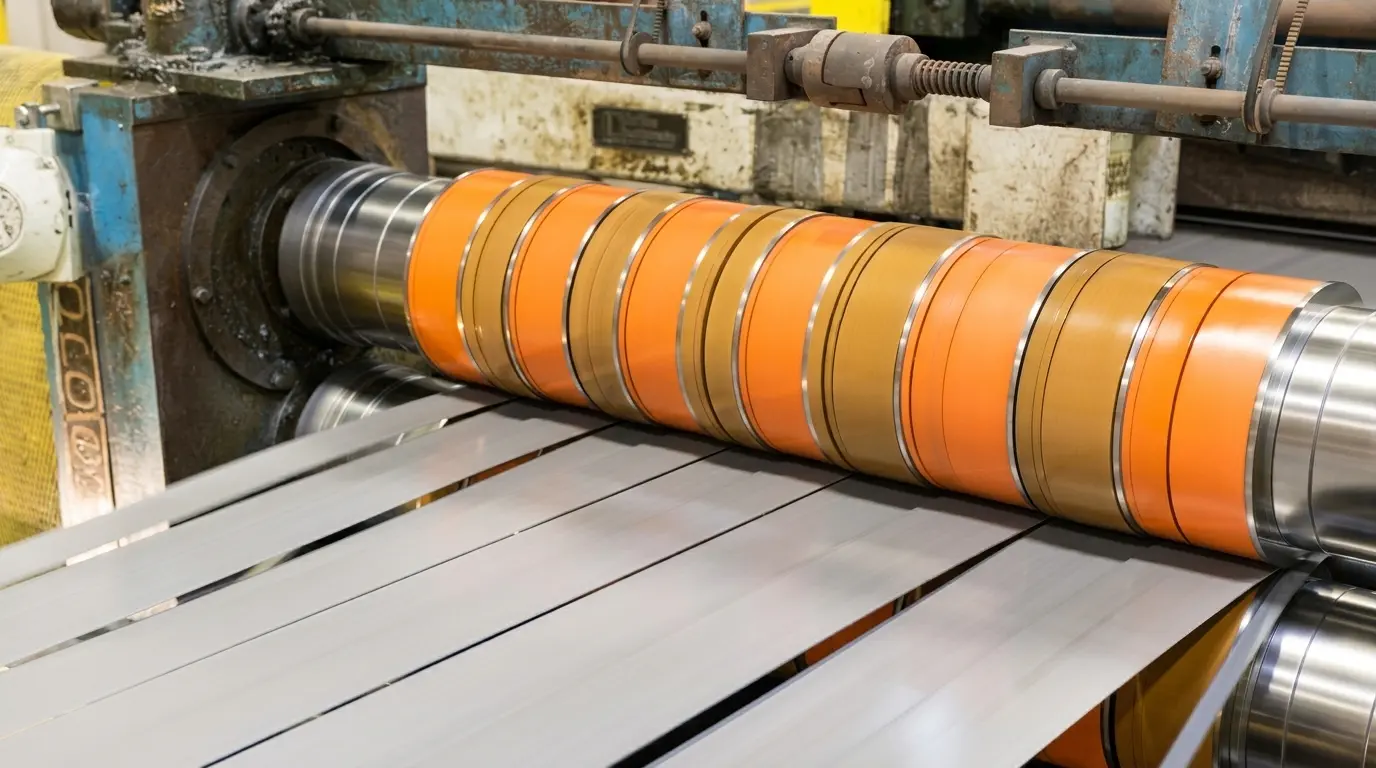
Control Edge Trim and Slitting Machine Settings
Once the slitting pattern is established, machine setup and operating conditions determine whether the planned material utilization can be achieved consistently.
Set Edge Trim According to Incoming Coil Condition
Using the same edge trim allowance for every master coil may result in unnecessary material loss.
Incoming coils can differ in edge quality, width consistency, camber, and surface condition. Processors should inspect the material before deciding how much edge trimming is necessary.
A practical approach includes:
- Inspecting the incoming coil edges.
- Identifying cracks, damaged sections, and irregularities.
- Determining the minimum trim required to meet finished-product specifications.
- Confirming that the planned trim allowance is compatible with the slitting pattern.
This approach helps avoid excessive trimming while maintaining the required edge quality.
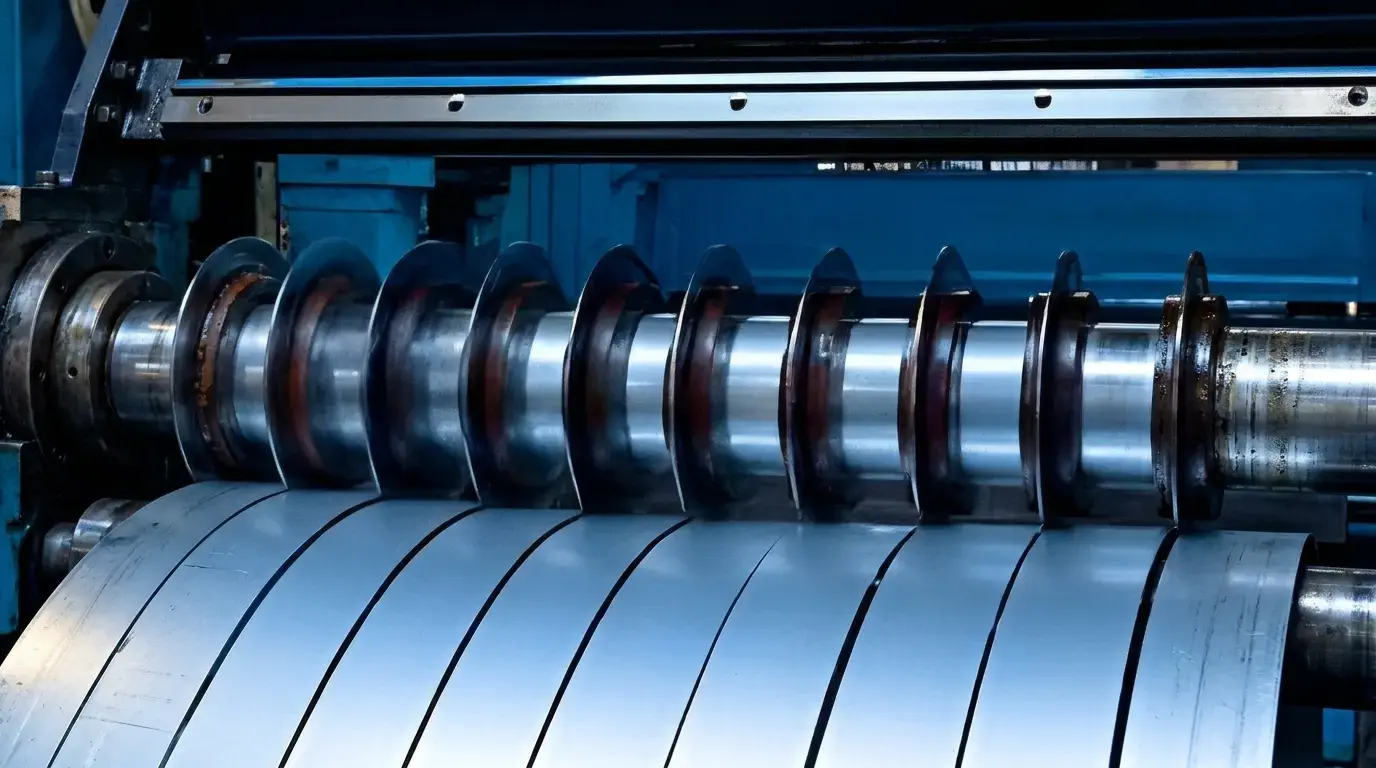
Optimize Slitting Knife Clearance and Overlap
Knife clearance and overlap are important setup parameters that affect cutting quality.
Incorrect clearance can contribute to excessive burrs, poor edge quality, and dimensional problems. Unsuitable overlap may also affect cutting stability.
The appropriate settings depend on factors such as:
- Material thickness.
- Steel grade and mechanical properties.
- Knife condition and geometry.
- Slitting machine design.
- Required edge quality and burr limits.
Operators should follow equipment and tooling specifications rather than applying one universal clearance or overlap value to every material.
Regular inspection of knives, spacers, and tooling alignment is also important. Worn or damaged tooling can create recurring defects and increase the amount of material that must be rejected or reprocessed.
Maintain Proper Strip Tension and Alignment
Stable tension is necessary to maintain consistent strip movement throughout the slitting process.
Poor tension control can contribute to strip wandering, uneven winding, loose coils, and other handling or dimensional problems.
Processors should pay attention to:
- Consistent tension across the slitting line.
- Correct alignment of the incoming master coil.
- Stable recoiling conditions.
- Proper positioning of separators and winding equipment.
- Regular inspection of tension-control components.
The objective is to maintain stable strip handling from uncoiling through slitting and recoiling. This reduces avoidable defects and helps protect the finished strips.
Reduce Setup Waste Through Better Production Planning
Not all scrap originates from cutting operations. Production scheduling also affects how frequently machines need to be reconfigured and how much material is consumed during setup.
A more organized production plan can reduce unnecessary adjustments and improve the consistency of slitting operations.
Several practices can help:
- Group compatible orders: Schedule orders with matching grades, thicknesses, and processing requirements together where practical.
- Reduce unnecessary knife changes: Plan production sequences to avoid frequent changes in knife configuration.
- Confirm specifications before production: Verify strip widths, quantities, tolerances, and packaging requirements before loading the master coil.
- Standardize setup procedures: Maintain documented settings and inspection steps for recurring material specifications.
- Record successful production parameters: Use previous production records as references when processing similar orders.
These practices can reduce repeated trial runs and avoidable setup losses.
However, production scheduling should also consider delivery deadlines, inventory requirements, and equipment availability. Combining orders is useful only when it does not create greater costs or operational complications elsewhere.
Calculate and Monitor Slitting Yield
Scrap reduction should be measured rather than judged by visual inspection or operator estimates.
Tracking scrap rate and slitting yield helps processors identify inefficient production runs and determine whether corrective actions are working.
How to Calculate Scrap Rate and Slitting Yield
Two basic formulas are useful:
Scrap Rate (%) = (Scrap Weight / Input Coil Weight) × 100%
Slitting Yield (%) = (Saleable Strip Weight / Input Coil Weight) × 100%
These figures assume that all input material is accounted for as either saleable output or scrap. If recoverable remnants, work-in-progress, or other material categories are recorded separately, the reporting method should define how they are treated.
Track Scrap by Category Instead of Using One Total Figure
A single scrap-rate figure shows the overall result but does not explain why material is being lost.
Processors should record scrap by category to identify the largest opportunities for improvement.
| Scrap category | What to monitor | Potential improvement |
|---|---|---|
| Edge trim | Trim width and weight | Improve incoming coil inspection and trim planning |
| Setup scrap | Start-up and adjustment losses | Standardize machine setup |
| Defect scrap | Burrs, width deviations, surface damage, and winding defects | Improve tooling, alignment, and process control |
| Coil-end waste | Unusable coil-end weight | Improve order planning and remnant management |
| Unused width | Width left after slitting | Optimize slitting patterns and order combinations |
Comparing these records across different grades, thicknesses, coil widths, and production runs can reveal recurring problems.
For example, consistently high setup scrap may indicate that machine settings are not sufficiently standardized. High unused-width losses may instead point to poor order combinations or unsuitable master coil selection.
Build a Continuous Scrap Reduction Process
Reducing scrap is not a one-time adjustment. It requires a continuous process that connects purchasing, production planning, machine operation, and quality control.
A practical improvement process can follow these steps:
- Establish a baseline: Record input coil weight, saleable output, and scrap by category.
- Identify the main loss source: Determine whether the largest losses come from edge trimming, setup, defects, or unused width.
- Prioritize corrective actions: Address the highest-impact and most avoidable losses first.
- Standardize improvements: Document successful slitting patterns, machine settings, and inspection procedures.
- Review production results: Compare scrap rate and yield before and after each improvement.
- Update purchasing and scheduling decisions: Use production data to improve master coil selection and order combinations.
This process also helps improve communication between departments. Purchasing teams can consider material dimensions and incoming quality, production planners can optimize order combinations, and operators can provide feedback on machine performance.
Over time, this coordination can reduce avoidable material losses while maintaining consistent product quality.
Conclusion
Reducing scrap in steel coil slitting requires a combination of material planning, production control, and equipment management.
The most effective starting points are to identify the main sources of scrap, optimize slitting patterns, control edge trimming, maintain suitable machine settings, and monitor material utilization with consistent production records.
For steel processors and buyers, material quality and dimensional consistency also influence how efficiently incoming coils can be converted into finished strips. Working with a reliable steel coil supplier and clearly defining material specifications can help establish a more predictable production process.
Weijunli Steel supplies steel products and supports custom steel processing solutions for industrial buyers. By communicating your required material specifications, dimensions, and processing needs in advance, you can evaluate suitable supply options for your downstream operations.